Updated: November 2026
Hyundai solar panels sold in the US are made in South Korea, at HD Hyundai Energy Solutions’ cell and module plant in Eumseong County, North Chungcheong Province. The one exception we know of is the shingled line, which pv magazine reported in 2021 was built by a contract manufacturer (an ODM) in China. Hyundai has no solar panel factory in the United States.
Hyundai solar panels in stock
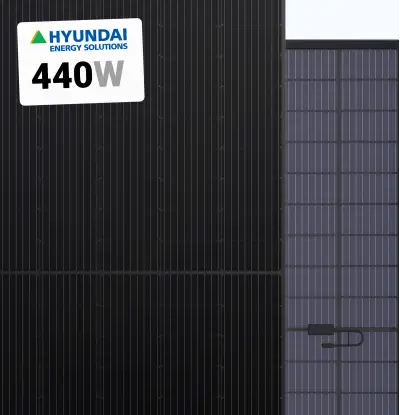 8% OFFHyundai 440W Solar Panel 108 Cell N-Type TOPCon Bifacial All-Black HiN-T440NF(BK)5.00 (1)
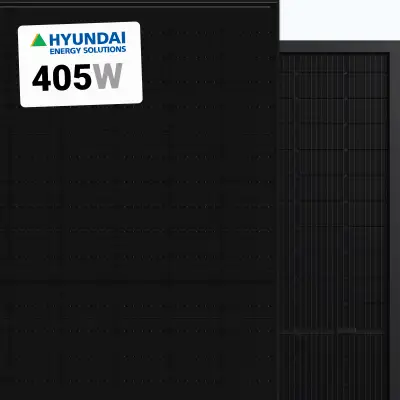 5% OFFHyundai 405W Solar Panel 132 Cell PERC Bifacial HiS-S405YH(BK) Clearance4.75 (4)
 19% OFFHyundai 440W Solar Panel 108 Cell N-Type TOPCon Bifacial All-Black HiS-T440NF(BK) Clearance5.00 (1)
 9% OFFSolarever 450W Solar Panel 96 Cells N-Type Bifacial All-Black SE-182*105-450M-96-BD Clearance5.00 (2)
 30% OFFZNShine Solar 410W Solar Panel 108 Cell ZXM7-SH108-410 Clearance5.00 (4)
 16% OFFTrina 415W Solar Panel 144 Cell TOPCon Bifacial All-Black TSM-415NE09RC.05 Clearance4.67 (6)
 JA Solar 440W Solar Panel 108 Cell N-Type Bifacial JAM54D41-440/MB Clearance4.33 (3)$230.82Buy nowIn stock
 Phono Solar 440W Solar Panel 108 Cell PERC Bifacial PS440M8GFH-18/VNHB Clearance5.00 (2)$182.34Buy nowIn stock
 REC 460W Solar Panel 88 Cell HJT All-Black REC460AA PURE-RX4.75 (4)$387.46Buy now
The company behind the panels is HD Hyundai Energy Solutions. It belongs to the HD Hyundai shipbuilding group and is a separate company from Hyundai Motor. We’re an independent buyer’s desk that writes about these panels. We don’t make, sell or install them, and nothing on this page speaks for HD Hyundai.
Our take: “Made in Korea” is a fair description of where a current Hyundai module is assembled. It doesn’t fully answer where the cells inside come from, because the Eumseong plant makes far fewer cells than its module lines use, and the company doesn’t say where the rest come from. If you’re paying cash for a system on your own house, that gap has no federal tax consequence in 2026. If you’re an installer on a commercial, lease or PPA job, get the answer from your supplier in writing.
Need solar panels installed?
Fill out form and compare offers from solar professionals
An $85 million US order shows where Hyundai panels come from
The clearest recent evidence comes from a single sale. On April 3, 2026, HD Hyundai Energy Solutions announced a module supply contract worth about $85 million with Hillsboro Solar Project LLC, a US utility-scale project. The order equals 30.3% of the company’s 2024 annual revenue, and deliveries run from the second quarter of 2026 through the first quarter of 2027.
According to the company’s press release, published by pv magazine USA, the project’s high-output bifacial modules are “produced entirely at the company’s state-of-the-art smart factory in South Korea.” The release credits the company’s “advanced cell and module manufacturing infrastructure built in South Korea” and presents the deal as an answer to US demand for “enhanced supply chain transparency and traceability.” It also says the company is “reviewing various options for producing key solar equipment in South Korea.” No US factory is named anywhere in it.
Hyundai’s US supply ships from Korea, and the company sells that as a feature, so it should be willing to document origin when a buyer asks. But “produced entirely” at the Korean factory describes where the modules were built. It doesn’t say that every cell in them came off Hyundai’s own cell line, and the capacity numbers below show that can’t be true of everything the plant ships when it runs flat out.
The US market now matters almost as much to the company as its home market. Bizwatch, a Korean business paper, reports US revenue of 65.8 billion won in Q2 2026, up from 15.6 billion won in Q2 2025. That made the US 40% of total revenue, against 44% from Korea.
Hyundai’s solar factory is in Eumseong, South Korea
The independent test lab PVEL confirms the location: its 2024 PV Module Reliability Scorecard lists the Hyundai bills of materials it tested as produced in Soi-myeon and Eumseong-gun, South Korea. Bizwatch dates the original cell plant to 2007.
| Date | Module capacity (per year) | Cell capacity (per year) | Utilization | Source |
|---|---|---|---|---|
| March 2021 | 1.35 GW, after a new 750 MW module factory | 1.37 GW PERC cell factory planned | not reported | pv magazine, 2021-03-12 |
| October 2026 | about 1.2 GW | about 400 MW (one-third of module capacity) | H1 2026: modules 77.4%, cells 96.6% | Bizwatch, 2026-10-15 |
What this means for you: the module lines have spare room, but the cell line is small and almost fully booked. A Hyundai module assembled in Eumseong may contain cells from another maker, and the “made in Korea” on the label won’t tell you either way.
We should flag a mismatch. In 2021, pv magazine reported a planned 1.37 GW PERC cell factory, with the cells going only into Hyundai’s own modules for the Korean and US markets. By October 2026, Bizwatch puts cell capacity at about 400 MW. We couldn’t find a document that explains the difference: whether the 2021 plant was built smaller, built and later cut back, or converted to another cell type. The 2026 figure is the current one, and it’s the one we use below.
Where the cells inside Hyundai panels come from: the math
Hyundai’s own cell line can supply roughly a third of its module output, and the company doesn’t say where the rest comes from. Here is the arithmetic, using two simplifying assumptions: one watt of cells per watt of finished module (in reality there are small cell-to-module losses, but they don’t change the picture), and first-half 2026 utilization holding for the full year.
At full capacity: 400 MW of cells ÷ 1,200 MW of modules ≈ 33%. About 800 MW of cells a year, or two-thirds of what the module lines can use, would have to come from somewhere else.
At first-half 2026 rates: modules at 77.4% of 1,200 MW comes to about 929 MW a year, and cells at 96.6% of 400 MW to about 386 MW. 386 ÷ 929 ≈ 42%. So even with the module lines running below capacity, about 540 MW a year of cells would come from outside Hyundai’s own line.
None of the documents we checked, including the Hillsboro release, the company’s cell announcements and the Bizwatch report, name a supplier or a country for those outside cells.
Hyundai’s TOPCon plans make the picture a bit odder. In April 2025 the company began mass production of N-type TOPCon cells on its “Korean manufacturing base” and said it planned to “supply Korean-made cells directly to U.S. manufacturers, backed by its licensed TOPCon technology.” At RE+ 2025 it said the licence lets it “produce solar cells in Korea and export them to the U.S.” Selling cells to other manufacturers while your own module lines are short of cells is a strange fit, and we’ve seen nothing from the company that explains how the two plans work together. Bizwatch reports that a cell expansion is being “reviewed positively”, with no timing set. The options include the idle land at Eumseong or a new plant in Korea or abroad.
Current Hyundai modules for the US are assembled in Korea, and some of the cells in them are Hyundai’s own Korean-made cells. A buyer can’t assume that a given panel contains Hyundai cells, and also can’t assume the outside cells come from any particular country, China included. There’s no public evidence either way. For a project where cell origin has legal weight, it has to come from documents for the specific shipment. The brand name won’t settle it.
Hyundai solar panels are not made in China, with one exception
The exception is the shingled modules, the VG and HG series, which pv magazine reported in 2021 were produced through an original design manufacturer (ODM) in China. Apart from those, we found no document showing a Hyundai module line in China or anywhere else outside Korea.
| Product line | Status | Cells | Module assembly | Evidence |
|---|---|---|---|---|
| Residential N-type TOPCon, NF(BK) series (108-cell, 22.3% to 22.9% efficiency at launch) | Current; launched for the US at RE+ 2024 | Part Hyundai’s own Korean TOPCon cells (mass production from April 2025); the outside share is not disclosed | South Korea | TaiyangNews (Nov 2026) reports the company supplies the US from an “integrated cell and module manufacturing facility in South Korea” and already sells half-cut residential TOPCon modules there |
| Utility bifacial modules (such as the Hillsboro order) | Current | Not stated for the order | South Korea, “produced entirely” at the company’s smart factory | Company release, April 2026 |
| Shingled VG / HG series | See our shingled models page | Not published | China, through an ODM | pv magazine, March 2021 |
| Older PERC modules | Older line; current availability not confirmed | Hyundai planned its own PERC cells (1.37 GW, 2021) for its own modules; how much came from that line is not published | South Korea | pv magazine, March 2021 |
At RE+ 2026 (November 17 to 19, Las Vegas) the company also showed a multi-cut TOPCon module with a claimed 24.4% efficiency. We haven’t seen a datasheet or an assembly site for it yet, so it isn’t in the table.
There is no Hyundai solar panel factory in the USA
As of November 2026, HD Hyundai Energy Solutions has no module or cell factory in the United States. Its US operation sells and supports products made in Korea. At RE+ 2025 the company said it “is also reviewing potential local investments to align with evolving market conditions,” without giving a site, a date or an amount, and at the same show it announced a 36 MW module supply deal with US developer Turning Point Energy. The April 2026 Hillsboro release names no US plant either.
Two possible mix-ups are worth heading off. HD Hyundai Electric, a sister company, does have a US business, but it sells battery energy storage through a Texas entity, not panels. And the large solar factories in Georgia belong to Hanwha Qcells, which is a different Korean group.
If a quote or a used-panel listing describes a Hyundai panel as “Made in USA,” ask to see the document behind the claim. We know of no US-made Hyundai panel.
HD Hyundai Energy Solutions makes the panels, not Hyundai Motor
pv magazine described HD Hyundai Energy Solutions in 2021 as a unit of the shipbuilding group Hyundai Heavy Industries, and it has been in the module business since 2004. Some reviews still call it a branch of the company that owns Hyundai Motor. The two share a name but they’re separate businesses, and that matters when something goes wrong. Your local Hyundai car dealer will gladly talk to you about a crossover, but can’t do anything about a panel warranty claim. Those go through your installer and the solar company.
FEOC rules matter for commercial and leased systems, not cash home purchases
For a homeowner paying cash in 2026, FEOC compliance doesn’t affect any federal credit, because there is no longer a federal residential solar credit to claim. The IRS page for the Residential Clean Energy Credit (Section 25D) says: “The credit is not available for any property placed in service after December 31, 2025.” No credit means no foreign-entity test to pass.
FEOC (“foreign entity of concern”) is the common shorthand. Current law and guidance use the term “prohibited foreign entity” (PFE). A 2025 change to the tax code added PFE restrictions to the clean electricity credits (Sections 45Y and 48E) and to the 45X manufacturing credit. Projects claiming 45Y or 48E that begin construction after December 31, 2025 have to show they did not receive “material assistance” from a prohibited foreign entity. On February 12, 2026 the IRS issued Notice 2026-15, which gives interim safe harbors for working this out with a “material assistance cost ratio.” Treasury and the IRS say they intend to propose regulations, including on how a PFE is defined, so the details may still change.
This is where the question matters:
- Commercial systems claiming 48E or 45Y.
- Leases and PPAs on homes. The third-party owner claims the commercial credit, so the rules apply to the owner even though the homeowner never files anything.
- Installers and developers who have to document the equipment cost ratio for those projects.
A Korean manufacturer, and modules assembled in Korea, help with this. The TaiyangNews report ties Hyundai’s Korean cell-and-module setup directly to US supply chain rules, including FEOC. But we found no public FEOC or PFE certification from Hyundai, and the cell gap described above means the module’s country of assembly doesn’t answer the question alone. On a commercial or third-party-owned job, ask the supplier for the written documentation the notice’s safe harbors rely on, covering the specific modules being delivered. This is a summary of public IRS material and not tax or legal advice. A project that depends on the credit needs a tax professional to look at it.
Tier 1 status for Hyundai panels is hard to confirm; PVEL results are not
We can’t tell you whether Hyundai is on the current BloombergNEF Tier 1 list. The list is paywalled, and we don’t have a primary source for Hyundai’s current listing. Any page that says “Hyundai is Tier 1” without a date and a source is asking you to take it on trust. Keep in mind that Tier 1 is a measure of a manufacturer’s bankability for financed projects. It doesn’t rate how well a panel holds up.
What you can check is independent reliability testing. In PVEL’s 2024 PV Module Reliability Scorecard, HD Hyundai has 4 Top Performer designations, with Scorecard appearances in 2017, 2021, 2023 and 2024, and the 2024 test samples came from the Korean plant. For the full verdict on build quality and warranty, see our review: are Hyundai solar panels any good.
Hyundai solar panel origin: short answers
Are Hyundai solar panels made in Korea?
Yes, current Hyundai modules for the US are assembled at the Eumseong plant in North Chungcheong Province. The plant also makes cells, about 400 MW a year against about 1.2 GW of module capacity, so not every cell inside comes from Hyundai’s own line.
Is Hyundai Energy Solutions the same company as Hyundai Motor?
No. HD Hyundai Energy Solutions belongs to the HD Hyundai shipbuilding group. Hyundai Motor is a separate company, and car dealers can’t handle solar warranty claims.
Are Hyundai shingled panels made in China?
As of pv magazine’s 2021 report, yes: Hyundai’s shingled modules were produced through an ODM in China. They’re the one Hyundai line we know of that was made outside Korea. Details are on our shingled models page.
Do I need FEOC-compliant panels for a home system in 2026?
Not if you buy the system outright. The 25D credit ended for property placed in service after December 31, 2025, so there’s no credit test to meet. If your system is leased or on a PPA, the owner’s 48E credit is subject to the prohibited-foreign-entity rules, and the origin documents matter to them.
Before you sign
- Get the exact model code from the datasheet. “Hyundai 400 W” isn’t enough. The full model code tells you whether it’s a current TOPCon module, a shingled VG/HG panel or an older PERC model.
- Look at the nameplate label on the back sheet or frame (or ask for a photo of it). It shows the model and the stated country of manufacture. For a panel that’s already on your roof, compare it with our list of older Hyundai models and their replacements.
- On commercial, lease or PPA jobs, ask for the certificate of origin and the supplier’s PFE documentation for the modules actually being delivered, not just a brochure about the brand.
- Check the manufacturer name on the California Energy Commission (CEC) equipment list. It should name the actual manufacturer, not a reseller or an unrelated company with Hyundai in its name.
Once you know which model and origin you’re looking at, compare the quote against current US prices for Hyundai panels.