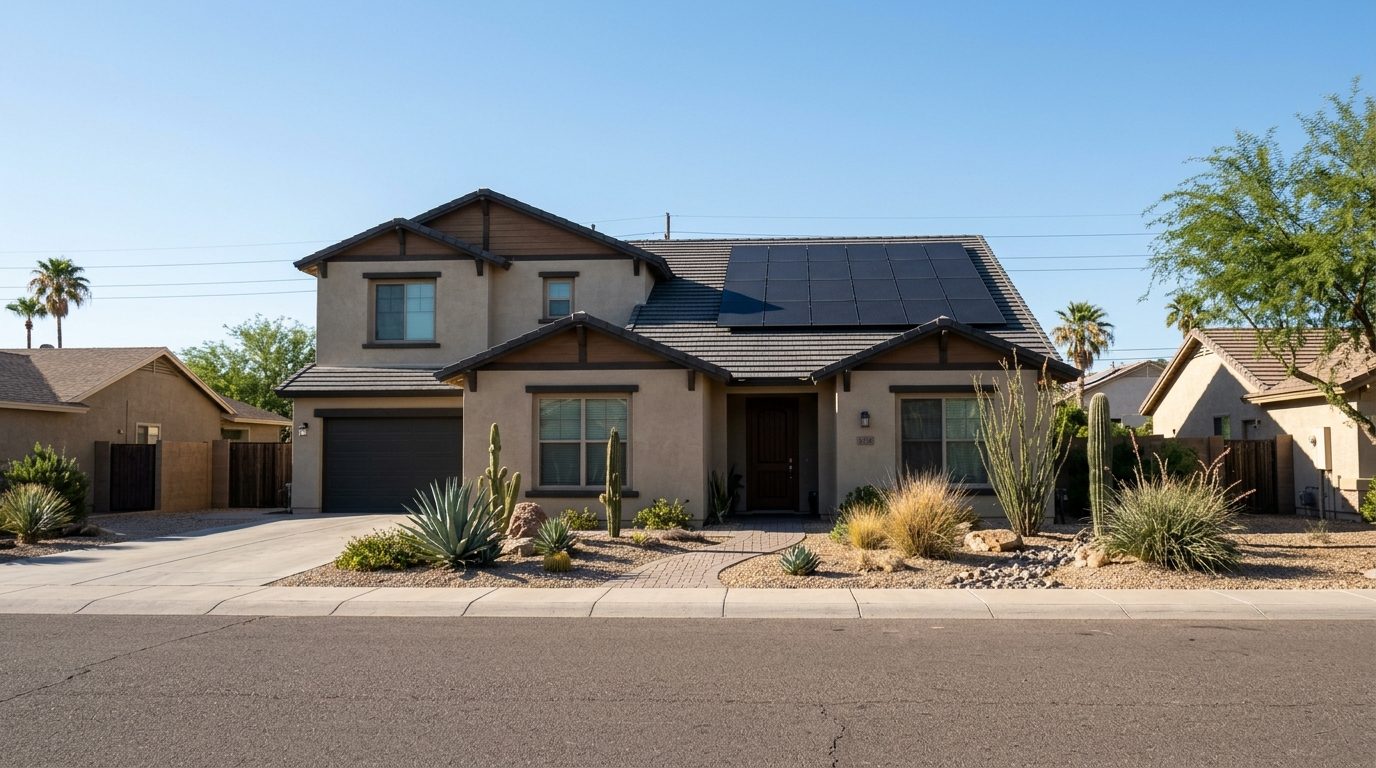
You have two quotes for about the same system. One uses Hyundai solar panels, the other uses Jinko, and the installer says they’re equivalent. They are close, but they aren’t the same.
Hyundai solar panels in stock
 8% OFFHyundai 440W Solar Panel 108 Cell N-Type TOPCon Bifacial All-Black HiN-T440NF(BK)5.00 (1)
 5% OFFHyundai 405W Solar Panel 132 Cell PERC Bifacial HiS-S405YH(BK) Clearance4.75 (4)
 19% OFFHyundai 440W Solar Panel 108 Cell N-Type TOPCon Bifacial All-Black HiS-T440NF(BK) Clearance5.00 (1)
 9% OFFSolarever 450W Solar Panel 96 Cells N-Type Bifacial All-Black SE-182*105-450M-96-BD Clearance5.00 (2)
 30% OFFZNShine Solar 410W Solar Panel 108 Cell ZXM7-SH108-410 Clearance5.00 (4)
 16% OFFTrina 415W Solar Panel 144 Cell TOPCon Bifacial All-Black TSM-415NE09RC.05 Clearance4.67 (6)
 JA Solar 440W Solar Panel 108 Cell N-Type Bifacial JAM54D41-440/MB Clearance4.33 (3)$230.82Buy nowIn stock
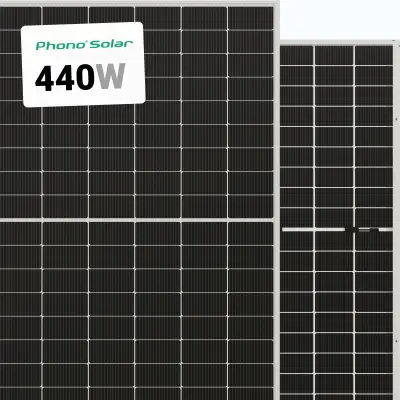 Phono Solar 440W Solar Panel 108 Cell PERC Bifacial PS440M8GFH-18/VNHB Clearance5.00 (2)$182.34Buy nowIn stock
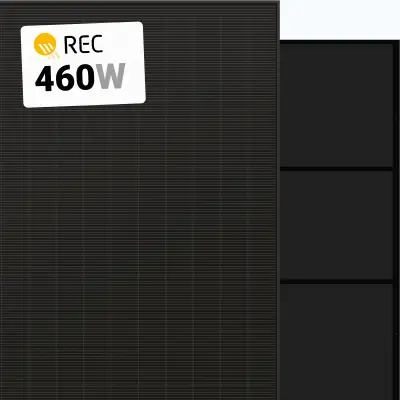 REC 460W Solar Panel 88 Cell HJT All-Black REC460AA PURE-RX4.75 (4)$387.46Buy now
Our take: the Hyundai HiN-T440NF(BK) is the better panel on paper. It has a 25-year product warranty, while Jinko’s US EAGLE G6R page lists 12 years, and it’s a bit more efficient (22.53% vs 22.02%). The Jinko is lighter (22.0 kg vs 24.5 kg) and loses a little less power in heat (-0.29 vs -0.30 %/°C). Both guarantee 87.4% of rated output at year 30. If the Jinko quote is clearly cheaper per watt, that can outweigh the gap between the panels.
We are an independent buyer’s desk. We aren’t HD Hyundai, and we don’t sell Jinko.
Need solar panels installed?
Fill out form and compare offers from solar professionals
Updated: November 2026
Choose Hyundai HiN-T440NF(BK) if
- You want the longer product warranty: 25 years vs 12
- You like the all-black, dual-glass bifacial build
- Your roof is tight and you need the most watts per square foot
- You're signing a lease or PPA and want Korean-made cells
Choose Jinko EAGLE G6R 440 W if
- Its quote is lower per watt with the same installer terms
- Your roof runs hot and there's room for an extra 40 mm of length
- You want the lighter panel: 22.0 kg
- Your installer stocks modules from Jinko's Jacksonville, Florida plant
| Hyundai HiN-T440NF(BK) | Jinko EAGLE G6R (JKM440N-54HL4R-B) | |
|---|---|---|
| Power (W) | 440 | 440 |
| Module efficiency (%) | 22.53 Edge | 22.02 |
| Pmax temperature coefficient (%/°C) | -0.300 | -0.290 Edge |
| NOCT (°C) | 44 Edge | 45 |
| Voc / Isc (V / A) | 38.80 / 14.39 | 39.57 / 13.80 |
| Dimensions (mm) | 1722 × 1134 × 30 | 1762 × 1134 × 30 |
| Weight (kg) | 24.5 | 22.0 Edge |
| Cells and build | 108 N-type TOPCon, bifacial, dual-glass | 108 N-type TOPCon, black backsheet and frame |
| Product warranty (years) | 25 Edge | 12 (US terms) |
| Performance warranty (years, % at end) | 30, 87.4% | 30, 87.4% |
| Cells and modules made in | Korea | Jacksonville FL, Malaysia or Vietnam |
| Owner of the US-supplying factory | HD Hyundai Energy Solutions | Jacksonville: FH Capital 75.1%, JinkoSolar 24.9% |
What this means for you: on a hot day the two panels produce within a couple of watts of each other. The warranty row and the price per watt on your quote matter more.
Jinko’s US datasheet covers the EAGLE G6R, JKM420-440N-54HL4-B (420–440 W). The spec listing we used for the 440 W panel is titled JKM440N-54HL4R-B. The Hyundai is dual-glass and bifacial. Our guide to Hyundai bifacial panels covers where that matters. From here on we call it the NF(BK).
Hyundai’s product warranty is 13 years longer
The power guarantee is the same for both panels: 1% loss in year one, then 0.40% a year, ending at 87.4% at year 30. On a 440 W panel that’s about 385 W. The difference is in the product warranty, which covers defects in the panel itself rather than its output.
The NF(BK) has a 25-year product warranty. Jinko’s EAGLE G6R page lists a “12-year product and 30-year linear power warranty”. The ComparePV spec listing says 25 years, which conflicts with the US page. On a US quote, the US terms are the ones that apply. Jinko’s US page states 12 years, so that is the figure to use. If you want to know what stands behind Hyundai’s warranty, see our full check of Hyundai.
Hyundai fits more watts on a roof, while Jinko handles heat slightly better
Both panels are rated at 440 W and are the same width, but the Jinko is 40 mm longer. That is why its efficiency is 22.02% and the NF(BK)’s is 22.53%. On a cramped roof, the shorter panel can sometimes fit one more module.
Heat favors the Jinko, by a small amount. Here’s a worked example. Assume a 65 °C cell temperature, which is 40 °C above the 25 °C test condition, and assume losses follow the Pmax coefficient. The NF(BK) loses 12.0%, about 52.8 W. The Jinko loses 11.6%, about 51.0 W. That’s a gap of roughly 1.8 W per panel, or 36 W across 20 panels.
The brand changes an 8.8 kW quote by a few hundred dollars
Take 20 panels at 440 W, which makes 8.8 kW. Anza reports a $0.30/W median for US-assembled modules through Q2 2026, so the panels cost about $2,640. The middle half of prices ran from $0.280 to $0.325/W, and that whole spread is $396 on this array. We have no brand-level price for either panel, so we can’t tell you which one is cheaper. Compare the quotes on total $/W, the installer’s workmanship warranty and the panel’s product warranty.
A cash buyer in 2026 also gets no federal credit. The IRS says the Residential Clean Energy Credit “is not available for any property placed in service after December 31, 2025.”
Where each panel is made matters mostly for leases
HD Hyundai Energy Solutions announced mass production of TOPCon cells in Korea in April 2025. At RE+ 26 in November 2026, it named its Korean cell-and-module production as its response to the FEOC rules.
Jinko shipped 86.8 GW in 2025 and says it was the world’s top module seller for the seventh time. In May 2026, FH Capital agreed to buy 75.1% of the company that runs Jinko’s 2 GW Jacksonville plant, and Jinko keeps 24.9%. According to pv magazine USA, the sale may help that plant meet FEOC rules. We couldn’t find which plant makes the G6R sold in the US.
Under the July 2025 budget law, a project loses the ITC if it uses components from prohibited foreign entities. For projects that start on or after January 1, 2027, the content threshold rises to 45%. Now that 25D is gone, this mainly affects leases and PPAs. If you’re signing one, ask where the panels were made.
A June 2026 trade petition names HD Hyundai
AMER is a group of three US manufacturers: Jeffersonville PV Cells, SEG Manufacturing and Heliene USA. It has asked Commerce to rule that South Korean cells made with Chinese-origin components circumvent the duties on Chinese solar products. The petition names Hanwha Q CELLS, HD Hyundai Energy Solutions and Shinsung E&G, and it asks for a country-wide inquiry. As of November 28, 2026 we found no Commerce decision. For you, that means asking how long the Hyundai price is held. If you also have a Q Cells quote, see Hyundai vs Q Cells.
Before you sign
- Read the product warranty years on the quote itself, not on a spec site.
- Compare total $/W and the workmanship warranty.
- Ask how long the Hyundai price is held.
- On a lease or PPA, ask where the panels were made.
Hyundai vs Jinko: quick answers
Is Hyundai still selling solar panels in the US?
Yes. HD Hyundai Energy Solutions showed a new TOPCon module at RE+ 26 in Las Vegas in November 2026, and it signed a 36 MW supply deal with US developer Turning Point Energy in 2025.
Can I mix a Hyundai and a Jinko panel on one string?
No. Their electrical values differ: 38.80 V / 14.39 A for the NF(BK) and 39.57 V / 13.80 A for the Jinko. Use one model per string.
Do both have a 30-year power warranty?
Yes. Both guarantee 87.4% of rated power at year 30, which is about 385 W on a 440 W panel.