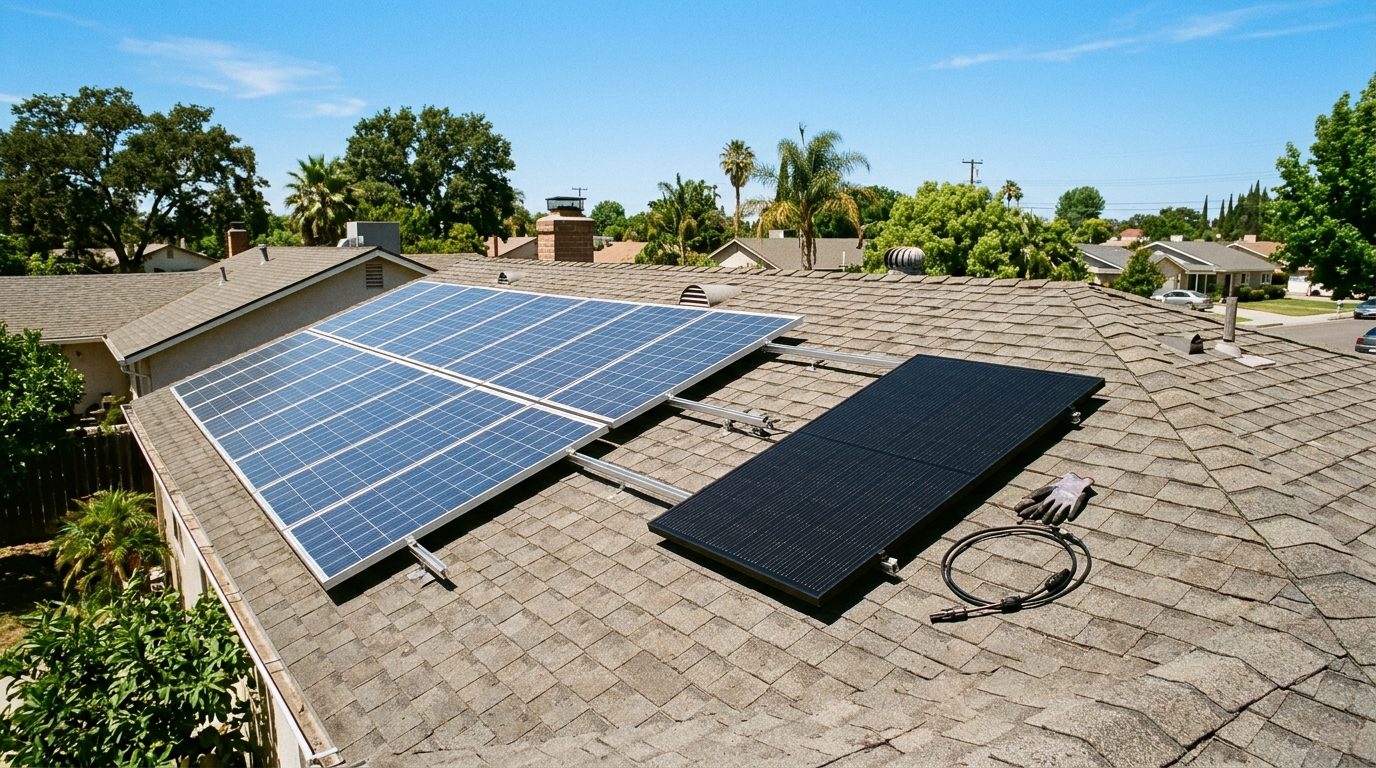
You have Hyundai panels from the 2010s on the roof and need one replacement, or a few more. Our take: Hyundai 250 watt solar panels (HiS-S250MG mono, HiS-M250MG multi; 60 cells, 1,645 × 983 mm) are not in HD Hyundai’s current US residential lineup as far as we found, and no current HD Hyundai panel matches them one for one. The nearest US residential panel, the 108-half-cell HiN-T440NF(BK), has similar voltage but much higher current and a bigger frame, so it belongs on its own string.
Updated: November 2026. Specs are from the CEC module list in NREL’s SAM library (June 23, 2026). We’re an independent desk, not HD Hyundai; here’s how we keep this table.
Hyundai solar panel lines by year
- 2009: UL certification for its PV modules (PV Tech, 2013).
- 2011: SG-Series; the 60-cell version ran 215–250 W at 983 × 1,645 × 35 mm (PV Tech).
- 2013: a 280 W 60-cell PERL module shown (PV Tech).
- 2020: Eumseong expansion to 1.35 GW of module capacity; M6 module at 450 W (Asia Economy).
- 2021: VI shingled PERC, 470–480 W, for Australia and Europe (pv magazine).
- 2024: N-TOPCon modules for the US shown at RE+ 2024: 108-cell for residential, 144/156-cell for commercial and utility, 22.3–22.9% efficiency (pv magazine).
- 2026: G12R TOPCon Multi-Cut at 24.4% shown at RE+ 2026 (Korea Herald); we follow launches on our news page.
The MG, RG, RI, HI and XG lines are in the CEC list, but we found no launch year for any of them, so they stay off the timeline.
Having trouble with your solar system?
Fill out form and compare offers from solar professionals
Old Hyundai models next to the current replacement
| Model | Cells | W | Voc (V) | Vmp (V) | Isc (A) | Imp (A) |
|---|---|---|---|---|---|---|
| HiS-M250MG | 60 | 250 | 37.6 | 30.9 | 8.6 | 8.1 |
| HiS-S250MG | 60 | 250 | 37.5 | 31.1 | 8.6 | 8.1 |
| HiS-S255MG | 60 | 255 | 37.7 | 31.3 | 8.7 | 8.2 |
| HiS-S260MG | 60 | 260 | 37.8 | 31.4 | 8.8 | 8.3 |
| HiS-S260RG | 60 | 260 | 37.9 | 31.1 | 8.9 | 8.4 |
| HiS-S290RG | 60 | 290 | 38.8 | 32.0 | 9.7 | 9.1 |
| HiS-S300RG | 60 | 300 | 39.1 | 32.3 | 9.9 | 9.3 |
| HiS-S305RI | 72 | 305 | 45.3 | 37.0 | 8.8 | 8.2 |
| HiS-S315RI | 72 | 315 | 45.7 | 37.4 | 9.0 | 8.4 |
| HiS-S320RI | 72 | 320 | 45.9 | 37.6 | 9.1 | 8.5 |
| HiD-S320RG(BK) | 60 | 320 | 40.6 | 33.7 | 10.04 | 9.57 |
| HiS-S320VG(BK) | 60 | 320 | 40.6 | 33.3 | 10.1 | 9.63 |
| HiS-S365RI | 72 | 365 | 47.6 | 39.3 | 9.9 | 9.3 |
| HiA-S365HI | 144 half | 365 | 47.21 | 39.39 | 9.77 | 9.27 |
| HiN-S365XG(BK) | 60 | 365 | 40.8 | 34.0 | 11.33 | 10.74 |
| HiN-T440NF(BK), current | 108 half | 440 | 38.8 | 32.3 | 14.39 | 13.63 |
What this means for you: the 60-cell panels and the NF(BK) sit at about the same voltage, Voc 37.5–40.8 V against 38.8 V. Current is where they part: 13.63 A against 8.1–10.74 A. The 72-cell rows run 45–48 V, and the “320 W” and “365 W” names each cover panels with different cell counts. HD Hyundai’s current 72-cell HiN-T590–600NI is a commercial panel, so for a roof the RI replacement is still the NF(BK) on its own string.
Mixing a 440 W panel into an old string wastes a large share of it
Ten HiS-S250MG in series give 10 × 31.1 V = 311 V at 8.1 A, about 2.52 kW at STC. Now add one HiN-T440NF(BK). A series string runs at one current, and the old panels hold it near 8.1 A, so the new panel makes roughly 8.1 A × 32.3 V ≈ 262 W instead of 440 W. Its Voc (38.8 V against 37.5 V) barely moves the string voltage, which is why the mix looks fine on paper.
So new panels go on a separate string, a separate MPPT input or microinverters. Your inverter manual says which of those it can take.
Warranty on discontinued Hyundai panels
Per EnergySage, the MG carried 25 years on output (to 80%) and 5 on materials (listing); the HiS-S300RG had 30 and 12. The NF(BK) gets 25 years on materials and 30 on output: 1% loss in year one, then 0.4% a year, ending at 84.5% (listing). We found no document saying whether old terms are still honored, so ask the manufacturer before you count on one.
Where to go next
- Current panels compared
How the HiN-T440NF(BK) stacks up against other current picks.
- New HD Hyundai releases
Launches like the G12R that could become the next replacement.
- How we source specs
Who keeps this table and where each value comes from.
Extending an old array
Read the full model code
The label code finds your row, not the wattage: 320 W and 365 W each cover different panels.Give new panels their own input
A separate string, MPPT input or microinverters stops 13.63 A panels from running at 8–9 A.Check the voltage limit
Add up the Voc of the planned string and compare it with the input limit in your inverter manual.
Replacing one broken panel
Measure the space
The NF(BK) is 1,722 × 1,134 mm. MG and 60-cell SG panels are 1,645 × 983, RG 1,640 × 998, RI 1,960 × 998.Check the clamps
MG and RG frames are 35 mm deep, the NF(BK) 30 mm. Confirm your clamps and rails take both.Keep it out of the old string
One new panel in an old series string works at the old current. A microinverter on it, or a used panel with your exact code, avoids that.
| Model | Series | Watts | Status |
|---|---|---|---|
| HiS-M250MG to HiS-S260MG | MG | 250–260 | Discontinued → HiN-T440NF(BK) |
| HiS-S260RG to HiS-S300RG | RG | 260–300 | Discontinued → HiN-T440NF(BK) |
| HiS-S305RI to HiS-S320RI | RI (72-cell) | 305–320 | Discontinued → HiN-T440NF(BK) |
| HiD-S320RG(BK), HiS-S320VG(BK) | RG(BK), VG | 320 | Discontinued → HiN-T440NF(BK) |
| HiS-S365RI, HiA-S365HI, HiN-S365XG(BK) | RI, HI, XG | 365 | Discontinued → HiN-T440NF(BK) |
| HiN-T440NF(BK) | NF(BK) | 440 | In stock |