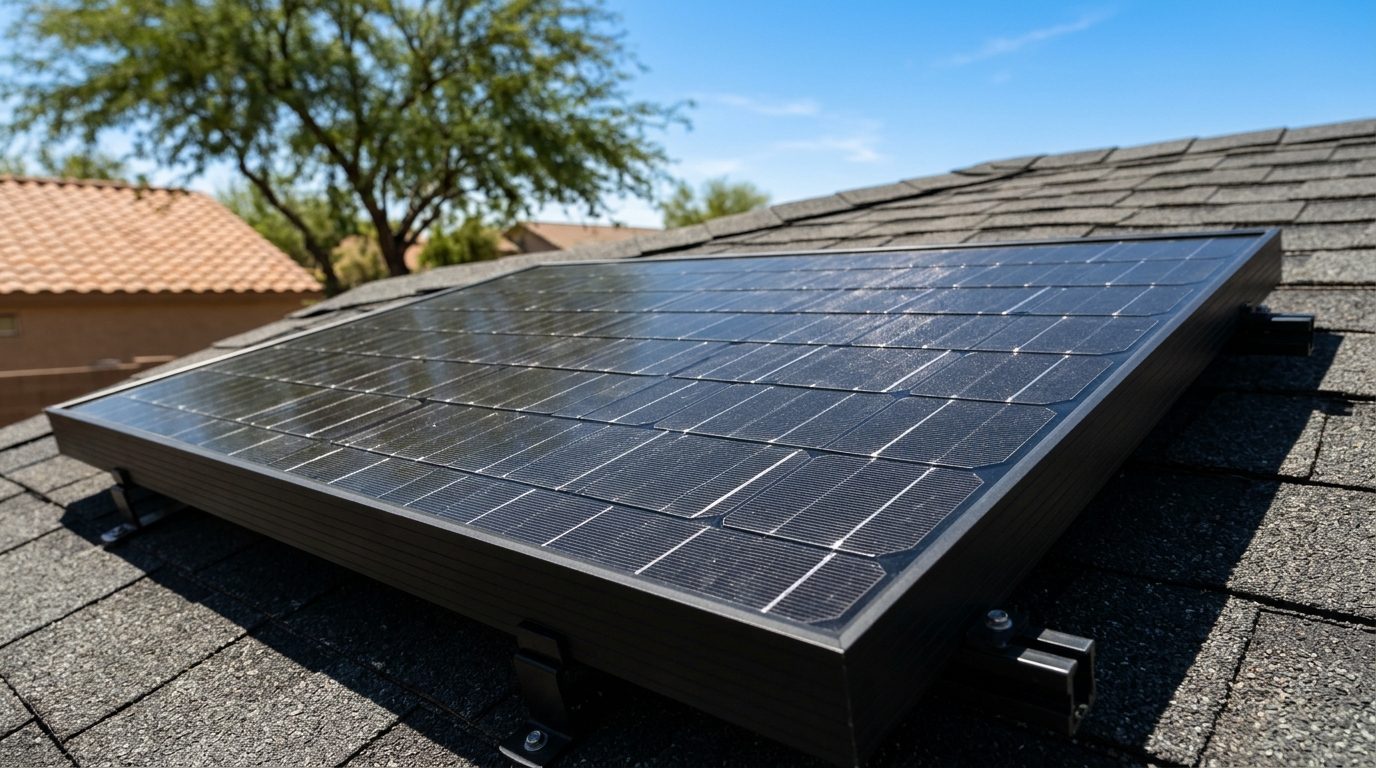
Good fit if
- You're in Australia or Europe, the markets Hyundai launched it for
- Roof space is tight: 400 W from 1.88 m², about 21.3%
- You need matching panels for an existing UF array
Look elsewhere if
- You're in the US: we found no HiE-S model on the CEC module list
- You need the 25-year product warranty to cover a US claim
- You want N-type cells; every Hyundai shingled panel is P-type mono PERC
Hyundai HiE-S400UF
HiE-S400UF (UF series)
- Shingled cells
- Mono PERC P-type
- 400 W
- Australia/EU market
- Pmax
- 400 W
- Vmp / Imp
- 41.0 V / 9.76 A
- Voc / Isc
- 49.5 V / 10.12 A
- Dimensions
- 1646 × 1140 mm
- Efficiency (from area)
- about 21.3%
- Cells
- 360 M3+ strips (158.75 mm), 10 strings of 36
- NOCT
- 42.3 °C
- Temp. coefficients
- Pmax −0.34%/°C, Voc −0.27%/°C
- Max series fuse
- 20 A
- Warranty
- 25-yr product (Australia/EU only), 25-yr performance
Updated: November 2026
You’ve found a HiE-S400UF in a quote, a listing or an old install. The Hyundai HiE-S400UF is Hyundai Energy Solutions’ 400 W shingled PERC module: 360 cut cells, 1646 × 1140 mm, Voc 49.5 V, about 21.3% efficient.
Hyundai solar panels in stock
 8% OFFHyundai 440W Solar Panel 108 Cell N-Type TOPCon Bifacial All-Black HiN-T440NF(BK)5.00 (1)
 5% OFFHyundai 405W Solar Panel 132 Cell PERC Bifacial HiS-S405YH(BK) Clearance4.75 (4)
 19% OFFHyundai 440W Solar Panel 108 Cell N-Type TOPCon Bifacial All-Black HiS-T440NF(BK) Clearance5.00 (1)
 9% OFFSolarever 450W Solar Panel 96 Cells N-Type Bifacial All-Black SE-182*105-450M-96-BD Clearance5.00 (2)
 30% OFFZNShine Solar 410W Solar Panel 108 Cell ZXM7-SH108-410 Clearance5.00 (4)
 16% OFFTrina 415W Solar Panel 144 Cell TOPCon Bifacial All-Black TSM-415NE09RC.05 Clearance4.67 (6)
 JA Solar 440W Solar Panel 108 Cell N-Type Bifacial JAM54D41-440/MB Clearance4.33 (3)$230.82Buy nowIn stock
 Phono Solar 440W Solar Panel 108 Cell PERC Bifacial PS440M8GFH-18/VNHB Clearance5.00 (2)$182.34Buy nowIn stock
 REC 460W Solar Panel 88 Cell HJT All-Black REC460AA PURE-RX4.75 (4)$387.46Buy now
Our take: it’s a good compact panel for a small roof, but in the US it’s an off-market part. Hyundai launched its shingled lines for Australia and Europe, and we found no HiE-S model on the California Energy Commission’s module list. We’re an independent buyer’s desk, not Hyundai and not a seller.
What “shingled” means on a Hyundai panel
A shingled panel has cells cut into strips and overlapped, the same idea as the roof under it, bonded with electrically conductive adhesive instead of soldered ribbons. Clean Energy Reviews lists the gains: shading one of the 10 strings doesn’t pull current down in the others, lower string current means less heat at hot spots, and the adhesive puts less thermal stress on cells, so fewer microcracks.
Need solar panels installed?
Fill out form and compare offers from solar professionals
The shade gain depends on where the shadow falls. A vent pipe’s shadow across a few strings is the case it helps; it can’t help when the whole panel is shaded. These are the review’s claims, not tests we ran.
How the UF, VG and HG series differ
| UF | VG | HG | HiS-S400YH(BK), US | |
|---|---|---|---|---|
| Cell format | M3+ 158.75 mm | M6 166 mm | G12 | half-cut |
| Cells | 360 | 340 | not stated | 132 |
| Power (W) | 375–400 | 385–410 | 435–445 | 400 |
| Efficiency (%) | 20.5–21.3 | 19.9–20.7 | up to 21.4 | 20.0 |
| 400 W model size (mm) | 1646 × 1140 | 1719 × 1140 | — | 1924 × 1038 |
| On CEC list (Nov 2026) | no | no | no | HiS-S line listed |
UF and VG per Clean Energy Reviews; HG per a 2023 European listing of the series; HiS-S400YH(BK) from our 400 W review. What this means for you: the UF gets 400 W from the smallest panel, the HG gets the most watts per panel, and only the US model is on the CEC list.
For the smallest roof, the UF. For an existing array, the same series and wattage already up there. For the most watts per panel, the HG, or in the US the 440 W NF(BK).
Footprint, worked from the dimensions
UF: 1.646 × 1.140 m = 1.876 m², and 400 W ÷ 1.876 m² = 213 W/m², about 21.3%. VG: 1.719 × 1.140 m = 1.960 m², or 204 W/m², about 20.4%. Ten UF panels cover 18.76 m² against 19.60 m² for ten VG, so the UF array needs about 0.84 m² (9 sq ft) less roof. Ten HiS-S400YH(BK) panels need about 1.2 m² (13 sq ft) more than the UF.
How many HiE-S400UF panels fit in a 600 V string
Assume a record low of −10 °C (14 °F), 35 °C below test conditions. At −0.27%/°C, Voc rises 9.45%.
- UF: 49.5 V × 1.0945 = 54.2 V; 600 ÷ 54.2 = 11.07, so 11 panels.
- VG: 46.4 V × 1.0945 = 50.8 V; 600 ÷ 50.8 = 11.8, so 11 panels.
Eleven UF panels reach 596 V, which is tight: below about −13 °C (9 °F) the string passes 600 V and you drop to 10. Use your own site’s design low. Check current too: Isc is 10.12 A (UF) and 10.97 A (VG) against the inverter’s input limit.
Hyundai shingled panels were launched for Australia and Europe, not the US
pv magazine reported in February 2021 that Hyundai launched the shingled PERC modules in Australia and Europe. In the CEC PV module list, Hyundai entries appear under HiA-S, HiD-S, HiG-S, HiN-S, HiS-M and HiS-S, but we found no HiE-S model name in November 2026.
In California, ask the installer how they’ll file an unlisted module for interconnection and any incentive paperwork; we don’t know a clean way round it. Then ask for the UL 61730 certificate for this exact model (none of our sources mentions one), which region’s warranty applies, and where the stock came from.
Warranty on the UF, VG and HG series
All three carry 25 years on product and 25 on performance. Per Clean Energy Reviews, UF and VG keep 84.8% at year 25 with 0.55% loss a year, and the product warranty covers Australia and the EU only. Solarproof’s UF entry instead gives 97.5% after year one, then about 0.73% a year. We can’t tell which copy is current, so ask for the dated warranty PDF. Brand reliability is covered in is Hyundai any good.
The HiE-S400VG is the older, cheaper generation
A German review by 42watt (August 2026) gives per-model efficiency of 20.4% (S400VG), 20.67% (S405VG) and 20.92% (S410VG). It calls the VG the older, cheaper generation next to Hyundai’s HeteroMax HJT line (22.0–23.0%, 30-year warranty), made in Eumseong, Korea. We found no independent US test. In Australia or Europe, the VG is a fair PERC panel if the price reflects its age; in the US it has the UF’s problem, in a bigger frame.
US Hyundai panels that do the same job
For 400 W on a US roof, ask about the HiS-S400YH(BK): bifacial, Voc 45.3 V, Isc 11.25 A, from the CEC-listed HiS-S line. It needs a bit more room. Extending an old array? See older models and replacements.
Before you sign
- Find the exact model on the CEC list.
- Get the UL 61730 certificate.
- Get the warranty region in writing.
- Ask where the panels came from.
- Recheck string length against your design low.
Neighboring models
- HiS-S400YH(BK), 400 W
The US-market 400 W Hyundai: bifacial, 20.0%, from the CEC-listed HiS-S line.
- HiN-T440NF(BK), 435/440 W
HG-class wattage in a US-market Hyundai panel.
- Older and discontinued models
Replacements for readers extending an array of older Hyundai panels.
Is the HiE-S400UF bifacial?
None of our sources calls it bifacial; they list every Hyundai shingled panel as mono PERC P-type. If a listing says bifacial, ask for the datasheet.
Is the UF for homes or utility projects?
Homes and small roofs. Hyundai’s commercial shingled lines are UH (450–480 W) and VI (465–490 W), per Clean Energy Reviews.
Who makes Hyundai shingled panels?
Hyundai Energy Solutions, a unit of Hyundai Heavy Industries, per pv magazine. The CEC list also carries the name HD Hyundai Energy Solutions.
What is the HiE-S400VG's Voc?
46.4 V, with Isc 10.97 A. At −10 °C that rises to about 50.8 V.